Short answer: A failed jurisprudence exam is a setback, not the end. NABP allows 5 attempts per jurisdiction to pass the MPJE and 5 lifetime attempts to pass the UMPJE (unless a board of pharmacy sets a different limit), and MPJE attempts do not count toward the UMPJE limit. To retake, you start the application over, pay the fees again and wait out the mandatory waiting period before NABP issues a new Authorization to Test. For both exams that wait is 30 days from the failed attempt, and some jurisdictions require longer.
This page covers what a retake involves, what your score report tells you, and how to use the time before your next attempt.
How many times can you take it?
NABP states: “Candidates are allowed 5 attempts per jurisdiction to pass the MPJE and 5 lifetime attempts to pass the UMPJE.” It also says “individual boards of pharmacy may have additional attempt limits,” so your own board has the final word.
Two details matter here:
The MPJE limit is per jurisdiction. Failing the MPJE for one state does not use up attempts for a different state.
MPJE attempts do not carry into the UMPJE. NABP says: “No, MPJE attempts are not counted toward the UMPJE.” If your state has moved to the UMPJE, you start the UMPJE with a fresh set of five. The UMPJE limit is lifetime, so it does not reset by state.
What a retake requires
NABP’s support page is direct: to retake the NAPLEX, MPJE or UMPJE, “candidates must begin the application process again,” including paying the application and examination fees. Eligibility must be approved by a board of pharmacy, and candidates must adhere to the waiting period before they receive a new Authorization to Test (ATT).
In practice:
1. Apply again. A failed attempt does not roll over into a new appointment. Treat it as a new application.
2. Pay again. Fees apply to every attempt. NABP’s Bulletin gives the UMPJE retake fee as $350 and says NABP will reconfirm your eligibility. Fees change, so check the current amount in your e-Profile before you apply.
3. Wait. NABP’s Candidate Application Bulletin sets the same rule for both exams: “you must wait 30 days (starting from the date of the failed attempt) before you will be allowed to schedule” the exam again. “Some jurisdictions require a longer waiting period,” and where one applies, that longer period governs. NABP calls the policy mandatory, with no exceptions, and for the UMPJE it will not issue a new Authorization to Test until the waiting period has ended.
4. Get approved. Your board has to approve your eligibility again before you receive the new ATT.
If you bought a score transfer: a retake needs a new transfer purchase. The one attached to your earlier attempt does not follow the new score. See how UMPJE score transfer and its 89-day window work.
What you get after a fail
NABP reports the result as pass or fail. When you fail, it provides a performance report with additional detail across the competency areas. That report is the most useful thing you will receive, because it tells you where to spend your next study hours.
Timing: where a candidate’s primary jurisdiction uses NABP’s online result platform, results arrive within 14 business days after the exam. Guam, Illinois and Minnesota require results directly from the jurisdiction, so those candidates hear from their board instead.
The early-attempt rule
Students who sit the early MPJE or UMPJE before graduation get one attempt before graduating. NABP says that attempt counts toward your total attempt limits, and a student who does not pass has to wait until after graduation to retest under the standard process.
Using your performance report
The UMPJE is built on four domains with fixed weights. Read your performance report against them and put the extra hours where the weight and your weakness overlap.
- Pharmacy and Pharmacist Practice — 30%. Scope of practice and delegated authority, USP compounding, adulteration and recalls, protection of patient health information.
- Medication Use Process — 30%. The full arc of a prescription, from issuing and dispensing to counseling, transfers and PDMP obligations. Tied for the largest share and the most learnable from experience.
- Regulatory Authority and Legal Obligations — 20%. Who has authority over what, from FDA and DEA to boards of pharmacy, plus controlled substance recordkeeping and liability.
- Pharmacy Operations — 20%. Licensures and registrations, pharmacy technology and the recordkeeping that goes with it, and access, storage and security of the pharmacy.
Three habits that tend to separate a pass on the second attempt from another fail:
Study the reasoning, not the answer key. If you only memorize which option was correct, a reworded question beats you. Make sure you can say why each wrong option is wrong.
Split the weak area from the weak habit. Missing a question because you did not know the rule is a content gap. Missing it because you misread “except” or “best” is a test-taking gap. They need different fixes.
Practice under timing. Take full-length sets with the clock running, then review every miss before you start another.
The UMPJE 4-week study plan is built around these same weights and works well as a restart plan, and the content outline explained goes domain by domain.
Frequently asked questions
How many times can I take the MPJE? Five attempts per jurisdiction under NABP policy, unless your board of pharmacy sets a different limit.
How many times can I take the UMPJE? Five lifetime attempts.
Do my failed MPJE attempts count against the UMPJE? No. NABP says MPJE attempts do not count toward the UMPJE.
Do I pay again to retake? Yes. NABP says you start the application over, including paying the application and examination fees.
How long do I have to wait? 30 days from the date of the failed attempt, for both the MPJE and the UMPJE, and some jurisdictions require longer. NABP calls it mandatory with no exceptions. Check your own board’s rules for a longer period.
Will I find out what I missed? You get a performance report with detail across the competency areas. NABP describes it as additional detail across those areas, so plan on a map of weak areas rather than a question-by-question review.
I took the exam before graduation and failed. What now? You wait until after graduation and retest under the standard process. The early attempt counts toward your attempt limits.
The bottom line
You have more attempts than most candidates realize, but each one costs a fresh application, fresh fees and a waiting period. Use the performance report to pick the weak domains, fix the reasoning behind each miss, and book the retake only when your practice scores say you are ready. The waiting period is 30 days from the failed attempt, longer in some jurisdictions, so confirm your board’s rule before you commit to a date.
References
- National Association of Boards of Pharmacy. Do previous MPJE attempts count toward the UMPJE attempt limit? nabp.pharmacy
- National Association of Boards of Pharmacy. Can I retake the exam if I do not get a passing score? nabp.pharmacy
- National Association of Boards of Pharmacy. MPJE Results. nabp.pharmacy
- National Association of Boards of Pharmacy. How many attempts do I have to take the early MPJE/UMPJE? nabp.pharmacy
- National Association of Boards of Pharmacy. NAPLEX/MPJE Candidate Application Bulletin. nabp.pharmacy

This article is not affiliated with, endorsed by, or sponsored by the National Association of Boards of Pharmacy or any state board of pharmacy. MPJE® and Uniform MPJE™ are trademarks of NABP. Licensure requirements change; always verify current requirements with your board of pharmacy and NABP before making decisions about your application or examination.
Free: try the UMPJE practice questions
Real questions from the same 750-question bank as the Master Guide, with a full explanation on every one. The first five need no signup.
Free: UMPJE 4-Week Study Tracker
A printable tracker built around the NABP domain weights — weekly checklists, a domain score log, and the test-day format at a glance.
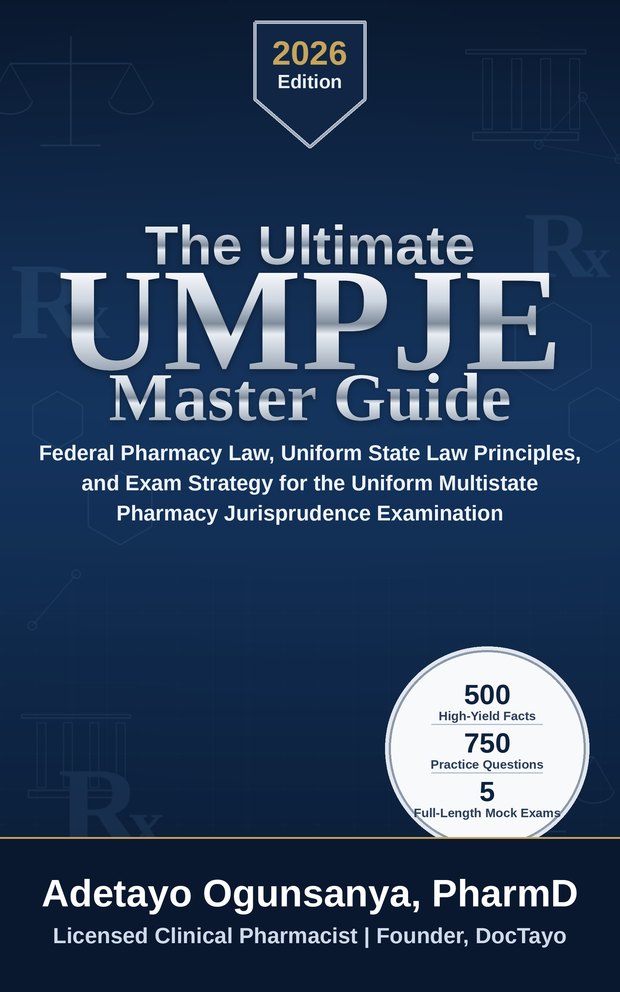
2026 Edition · $120
The Ultimate UMPJE Master Guide
501 pages built to NABP's four domains at their real 30/30/20/20 weighting — 750 practice questions with a rationale on every one, five 100-question mock exams and 500 high-yield facts. Instant digital download, and you keep it.