Short answer: Ohio began administering the UMPJE on April 1, 2026 as one of six early adopter states. But Ohio did something the other early adopters didn't — it kept the Ohio MPJE running until September 30, 2026. For six months, both exams existed.
Ohio also handles license transfer differently from every other participating state, which is the detail most likely to trip up an incoming pharmacist.
Before you plan around these dates: try the free UMPJE sample — real questions weighted across NABP’s four content domains, a full explanation on every answer, and the opening questions need no signup.
The dates
| UMPJE start | April 1, 2026 |
| Ohio MPJE retirement | September 30, 2026 |
| License transfer requirement | Must already hold a passing UMPJE or MPJE score in some jurisdiction |
Compare that to Arizona, Iowa, North Carolina, and Rhode Island, which retired their state exams on March 31, 2026 — a clean overnight switch. Ohio gave candidates a six-month runway.
One wording difference worth knowing before you call the board. NABP publishes Ohio's retirement date as September 30, 2026. The Ohio board never writes that date. Its February 2, 2026 resolution says that effective October 1, 2026 the board will no longer accept the Ohio-specific MPJE, and its licensure guidance carries the same boundary as a note on the application: for examination dates of October 1, 2026 or later, Ohio will only accept the UMPJE. Same boundary from opposite sides, and the two are easy to mistake for a discrepancy. Note also that the board draws the line at your examination date, not the date you applied or were found eligible.
A pass you already hold does not evaporate on October 1 — but it is not open-ended either. The board's resolution keeps a passing Ohio MPJE score obtained before that date valid, and its licensure guidance puts two limits on it: the score is good for three years, and only so long as no more than twelve months elapse between attempts. If you passed the Ohio MPJE and then paused, count three years from your examination date, not from the retirement date.
The license transfer difference
Ohio is one of two participating jurisdictions — Montana is the other — that does not simply answer "yes" to whether the UMPJE is required for licensure transfer. The condition NABP publishes for Ohio is that you must already have a passing UMPJE or MPJE score in some jurisdiction.
Read that as what it is: a pharmacist who has never sat a law exam anywhere does not get waved through on reciprocity. The Ohio board states the same rule from the other side — an applicant for reciprocity first licensed on or after January 1, 2018 who has not passed any jurisdiction's MPJE, the UMPJE, or an approved state law exam must sit the UMPJE. The board names Arkansas, California and Puerto Rico as the approved state law exams, which is wider than NABP's wording suggests, so a CPJE pass counts in Ohio even though NABP's table does not say so.
The mechanics of moving the license itself still run through NABP's Electronic Licensure Transfer Program (eLTP), as they do for every reciprocity applicant. That is the paperwork route, not the exam requirement; the two are separate and needing one does not excuse you from the other.
What to do: contact the Ohio Board of Pharmacy directly before assuming your existing law exam satisfies the requirement. This is the single most important line in this article for transfer candidates.
The overlap window, and why it is now closed
Ohio ran a six-month overlap in which candidates could sit either exam. It ended on September 30, 2026 — since October 1 the Ohio MPJE is neither offered nor accepted, and the UMPJE is the only law exam for Ohio licensure. What follows is how the choice was weighed while it existed, kept here because it still explains what each exam asks of you.
The case for the UMPJE was that you expected to seek licensure in other participating states. A UMPJE score is accepted by other adopters, so one exam covers multiple jurisdictions. That's the entire point of the redesign and the value compounds with each state.
The case for the Ohio MPJE was that you were staying in Ohio, had already built your preparation around Ohio law, and held a test date comfortably before the deadline. There's no benefit to switching exams mid-preparation just because one is newer.
Don't choose based on which sounds easier. The Ohio MPJE asks you to know Ohio's specific rules. The UMPJE asks you to reason about principles shared across states, with more federal depth. Different work, comparable difficulty.
Ohio's additional requirement
Ohio requires its own pharmacy law course for UMPJE and reciprocity applicants unless you're exempt. This is separate from the exam and it catches people out — passing the UMPJE does not, by itself, complete your Ohio requirements. The board's resolution is explicit: every applicant for licensure by examination who takes the UMPJE must complete a review of Ohio law and rules developed or approved by the board. The course instructions extend it to reciprocity applicants too, and exempt anyone who passed the Ohio MPJE before October 1, 2026.
Confirm your obligation with the Board. Requirements like this are exactly the kind of state-level detail the UMPJE doesn't cover and doesn't eliminate.
What changes about your studying
The Ohio MPJE tested Ohio law — the Ohio Revised Code and Administrative Code provisions governing pharmacy practice, Ohio-specific controlled substance rules, Ohio board requirements.
The UMPJE tests federal pharmacy law plus state-law principles common across jurisdictions. Practically:
Drop: Ohio-specific numbers, thresholds, and provisions that don't generalize.
Add depth: Federal law. DEA controlled substances, DSCSA, HIPAA, FDA authority, USP compounding standards. On a state exam these compete with state minutiae; on the UMPJE they're a larger share of a smaller field.
Keep: Corresponding responsibility, prescription validity, prescriber authority, counseling, recordkeeping, board disciplinary authority. Concepts transfer. Ohio's particular version of them doesn't.
And keep studying Ohio law for practice. You'll work under Ohio's rules daily regardless of which exam licensed you. The exam changed; the job didn't.
Frequently asked questions
I passed the Ohio MPJE before the transition. Do I need the UMPJE? No. A passing MPJE result for a participating jurisdiction on or before its transition date means you don't also take the UMPJE.
I have an Ohio MPJE appointment after September 30, 2026. It will be canceled and refunded. NABP cancels MPJE appointments scheduled on or after a jurisdiction's retirement date.
I'm transferring my license into Ohio. What do I do? File through eLTP, and check that you hold a passing law exam score Ohio accepts — any jurisdiction's MPJE, the UMPJE, or the Arkansas, California or Puerto Rico exam. If you hold none of those, you will sit the UMPJE. Confirm with the Ohio Board of Pharmacy.
Does the UMPJE cover Ohio pharmacy law? Not specifically. It covers principles common across states. Ohio's own requirements — including its pharmacy law course — sit outside the exam.
The bottom line
Ohio started the UMPJE on April 1, 2026 but kept the Ohio MPJE alive until September 30, giving a six-month window where both existed. That window closed on September 30, 2026; every Ohio candidate now sits the UMPJE. If you're transferring a license in, Ohio will not waive the law exam unless you already hold a score it accepts — confirm your pathway with the Board before assuming anything. And don't forget Ohio's separate pharmacy law course requirement, which the exam doesn't replace.
References
- National Association of Boards of Pharmacy. UMPJE Participating States. nabp.pharmacy — Ohio transition dates and transfer requirement
- National Association of Boards of Pharmacy. Uniform MPJE Launches for Early Adopter Boards of Pharmacy. nabp.pharmacy
- National Association of Boards of Pharmacy. Electronic Licensure Transfer Program. nabp.pharmacy
- National Association of Boards of Pharmacy. Uniform MPJE Content Outline (2025)
- State of Ohio Board of Pharmacy. Board meeting minutes, February 2, 2026 — the resolutions approving the UMPJE effective April 1, 2026, ending acceptance of the Ohio MPJE effective October 1, 2026, and requiring the Ohio law course. pharmacy.ohio.gov
- State of Ohio Board of Pharmacy. Ohio Pharmacist Licensure by Reciprocity and Pharmacist Licensure by Examination — accepted law exams and the October 1, 2026 examination-date cutoff. pharmacy.ohio.gov
- State of Ohio Board of Pharmacy — verify current licensure and course requirements directly

This article is not affiliated with, endorsed by, or sponsored by the National Association of Boards of Pharmacy or the Ohio Board of Pharmacy. MPJE® and Uniform MPJE™ are trademarks of NABP. Dates and requirements change; verify with NABP and the Ohio Board of Pharmacy before making decisions about your application.
Free: UMPJE Comprehensive Study Guide
Built from NABP’s published Content Outline and covering all four exam domains — what the Uniform MPJE actually tests, and how it differs from a state-specific MPJE. It is free; it just comes by email.
Free, and no payment at any point. Unsubscribe in one click.
Free: try the UMPJE practice questions
Real questions from the same 750-question bank as the Master Guide, with a full explanation on every one. The first five need no signup.
Free: UMPJE 4-Week Study Tracker
A printable tracker built around the NABP domain weights — weekly checklists, a domain score log, and the test-day format at a glance.
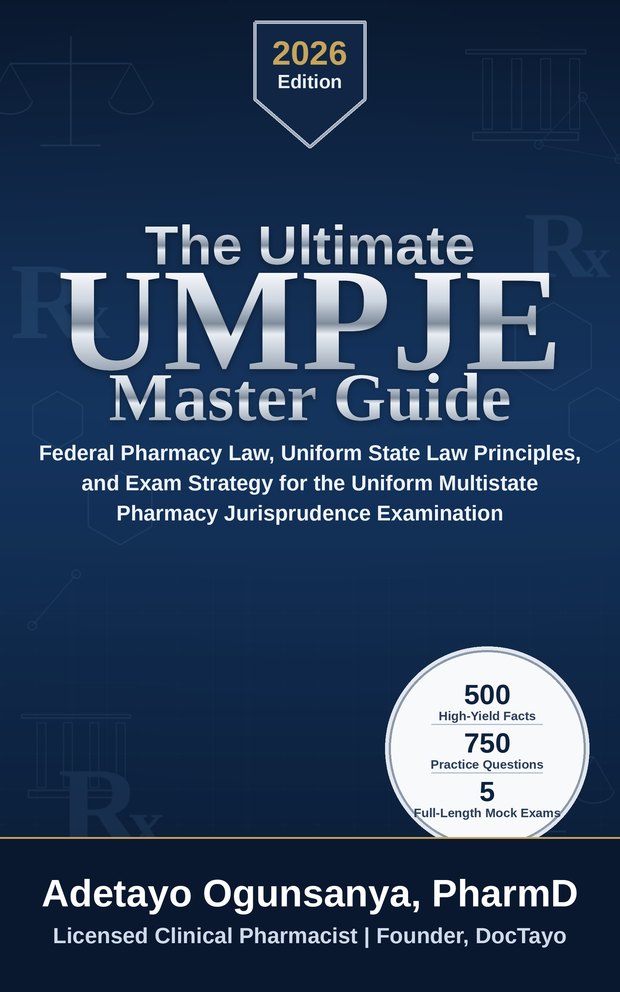
2026 Edition · $120
The Ultimate UMPJE Master Guide
501 pages built to NABP's four domains at their real 30/30/20/20 weighting — 750 practice questions with a rationale on every one, five 100-question mock exams and 500 high-yield facts. Instant digital download, and you keep it.