Whether you're sitting the UMPJE, MPJE or NAPLEX, navigating a medication or insurance decision, or building a pharmacy career — everything here is built by a practicing pharmacist with 10+ years in managed care and utilization management.
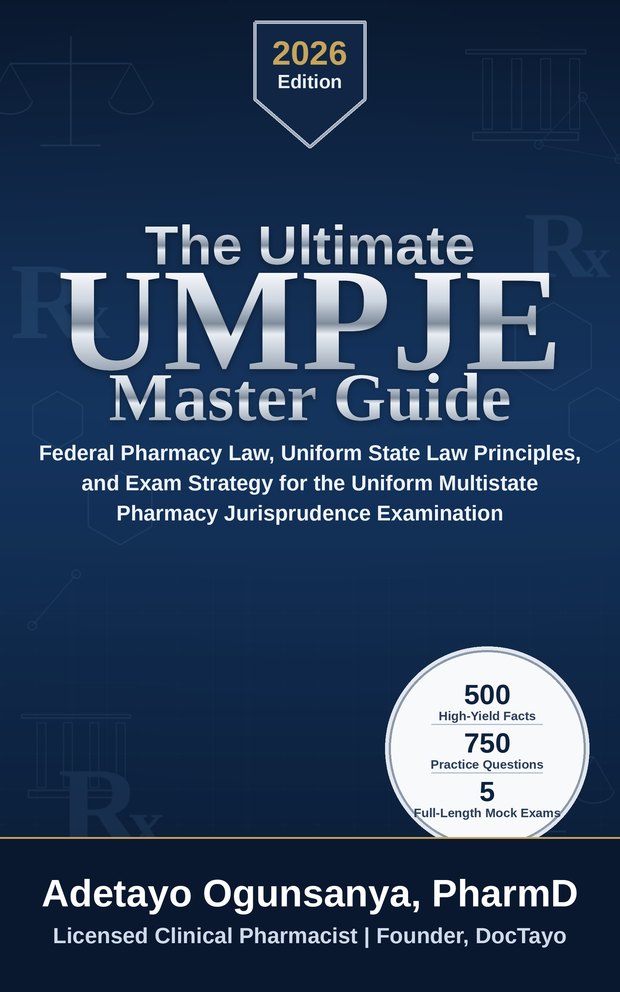
One book. The whole exam. 501 pages covering federal pharmacy law, the uniform state-law principles the Uniform MPJE actually tests, and a decision procedure for telling which one governs when they disagree.
Not sure yet? Try five questions from the same bank, free — no signup for the first five, and a full explanation on every one.
Pharmacist licensure
Thirteen jurisdictions moved to the Uniform MPJE this year. Thirty-one still set their own. Four run an exam of their own, and six require none. Every one checked against the board itself.
Find your stateFree · New
Every state-specific MPJE asks the same questions about state law — only the answers change. So I built that question set, and answered it in full for one state.
And if you would rather not do it yourself
I research a state against its practice act, board rules and controlled substances act and answer all 174, with the statute cited on every fact — the way Texas is done. A finished state guide is $129, and I build a state once five people have asked for it. Ask for yours — it costs nothing and commits you to nothing.
Mapped to the MPJE blueprint that takes effect 1 March 2027. Not for the UMPJE — check which exam your state uses.
How long is a prescription valid for each controlled schedule?
Schedule II — fill window
A Schedule II prescription must be dispensed within 30 days of the date it was issued.
It was 21 days until June 2021 — and a lot of study material still says 21. Every one of the 174 answers is cited like this.
Free video series
Two hours and forty-four minutes of lecture — one part for each of NABP’s four content domains, plus an opening part on how the exam itself works. Chapters on every video so you can jump to a single topic, and a good deal of it spent correcting things that are widely taught and are no longer true.
Watch the series →Built to NABP’s four content domains at their published weights. Leave your email and I’ll send it over, along with transition updates as more boards adopt the Uniform MPJE — the dates on this site are checked against the boards themselves, not copied from summaries.
One email when there is something worth sending. Unsubscribe in one click, and I do not pass your address on.
For health systems, pharmacies, PBMs, health plans, and pharmacist teams working on prior authorization strategy, PA/UM training, or applying AI to PA workflows.
Narration. Prior authorization isn’t just about making a decision. It’s about finding what the policy requires and what the record actually supports. Methuvia connects each requirement to its supporting evidence and source. The AI prepares the review. The pharmacist decides.
On screen. A title card, two synthetic cases, and a closing card. None of it is described aloud.
It opens on a title card: the METHUVIA AI mark, “Evidence-first clinical intelligence for prior authorization,” and “AI prepares the review. Pharmacists make the decision.”
The first case is DEMO-PA-002, Morgan Ellis: Rinvoq (upadacitinib) for M06.9, rheumatoid arthritis, marked Ready For Review. The engine selects a rheumatoid arthritis authorization pathway and notes that the pathway heading is context only and is not a scored criterion. It lists the three documents it read — a coverage policy, the prescriber’s request and a clinical chart note — each marked included and readable, at 98, 97 and 96 percent. Then it resolves criteria one at a time: diagnosis of rheumatoid arthritis, met, citing a rheumatology note documenting seropositive RA; patient is at least 18 years of age, met, documented at 52; inadequate response to methotrexate, met.
The second case turns on a PCSK9 inhibitor. A criterion reading “member has been adherent to a high intensity statin (see Appendix E) regimen for at least the last 4 months” is marked met, supported by a chart note recording atorvastatin 80 mg daily for the past 6 months and ezetimibe 10 mg daily concomitantly for the past 5 months, cited to chart notes page 1 and coverage policy page 2. A second criterion, coronary or other arterial revascularization, is also met. A summary panel then reads 24 requirements, 9 met and 15 not applicable. Opening a source brings up the coverage policy itself at page 2 of 8 — the Repatha (evolocumab) description and FDA-approved indications.
It closes on the recommendation: Approve, labeled the engine recommendation, advisory only and not the pharmacist decision, with the rationale that all required criteria are supported in the submitted documents. A case coverage determination screen follows, showing the advisory AI recommendation beside a pharmacist final decision reading “Not recorded,” with buttons for Approve coverage, Deny coverage, Request more information and Record pharmacist action, an empty pharmacist rationale field, and the notes that recording an action does not change the AI recommendation and that this is a case-level determination, not an appeal decision. The last frame is a closing card: the METHUVIA AI mark again, the same two lines, and “For PBMs, health plans, utilization-management organizations, and clinical pharmacy teams.”
Captions burned into the video read, in order: “Prior authorization review, grounded in evidence.” “Request form. Chart notes. Coverage policy.” “Every requirement evaluated.” “Requirement → supporting evidence → source.” “Traced to the policy page.” “Opens directly to the cited policy page.” “Advisory AI recommendation.” “Pharmacist final decision.”
The case screens carry a note in the corner: “Synthetic data. Illustrative cases.” The title and closing cards do not.
PA/UM strategy, training, and managed-care career consultations — from a 15-minute free call to project-based engagements.
An AI-assisted PA platform where a licensed pharmacist makes every final coverage decision. Learn why I'm building it.
I'm Adetayo “Tayo” Ogunsanya, PharmD, a licensed pharmacist with more than a decade of experience across clinical pharmacy, managed care, medication therapy management, prior authorization, and patient education.
Throughout my career, I have helped patients better understand their medications, supported healthcare organizations in making evidence-based coverage decisions, and worked to improve the safety, affordability, and effectiveness of medication use. I am licensed as a pharmacist in six states — Maryland, Washington DC, Virginia, New Jersey, New York, and Florida — all active and in good standing, and I bring experience from health plans, pharmacy benefit organizations, clinical review programs, and community pharmacy practice.
I created DocTayo.com to make trusted medication and health information easier to understand and use. Healthcare can feel complicated, especially when patients are navigating new prescriptions, insurance requirements, chronic conditions, or important treatment decisions. My goal is to translate complex medical information into practical guidance that helps people feel informed, prepared, and confident when speaking with their healthcare providers.
Beyond clinical practice, I am passionate about professional education, writing, public speaking, and mentoring the next generation of pharmacists and healthcare professionals. Through articles, books, consultations, presentations, and educational resources, I aim to provide information that is credible, accessible, and genuinely useful.
I'm also building METHUVIA AI, an AI-assisted prior authorization platform designed around a simple principle: the engine surfaces recommendations, but a licensed pharmacist makes every final coverage decision.
Learn about METHUVIA AI today →
At the heart of my work is a simple belief: people make better healthcare decisions when they are given clear information, thoughtful guidance, and the confidence to ask the right questions.
For health systems, pharmacies, and individual pharmacists working on prior authorization strategy, applying AI to PA/UM workflows, or a managed-care career move.