Preparing for the Texas MPJE can feel like walking into a legal maze wearing a white coat. You may be trying to understand the Texas Pharmacy Act, Texas pharmacy rules, controlled-substance laws, dangerous-drug requirements, federal pharmacy law, pharmacy classifications, technician responsibilities, record-retention rules, and dozens of reporting deadlines. The challenge is not simply remembering the laws. You must understand how those laws apply when a pharmacist is presented with a realistic situation involving a prescription, patient, prescriber, pharmacy employee, controlled substance, inspection, or operational problem. As a pharmacist licensed in multiple jurisdictions, I created my free Texas MPJE study guide to help candidates organize this material into a more practical and manageable review. This article explains what to study for the Texas MPJE, how to structure your preparation, which mistakes to avoid, and how to use the free guide as your exam approaches.
Download the Free Texas MPJE Study Guide
My free Texas MPJE study guide is designed to help pharmacy graduates and licensed pharmacists organize the most important Texas pharmacy law topics. It can help you:
- Identify high-yield Texas MPJE subjects
- Organize state and federal pharmacy law
- Review commonly confused rules
- Prepare for scenario-based questions
- Recognize important deadlines and exceptions
- Complete a focused review before exam day
Get the Free TX MPJE Study Guide
The free Texas MPJE Quick Facts Guide is ready. Enter your email and we’ll send it to your inbox right away. — you'll also get MPJE law updates and study tips going forward.
Use the guide alongside the current Texas Pharmacy Act, Texas pharmacy rules, controlled-substance laws, Board guidance, and federal pharmacy law. A study guide should make the law easier to navigate. It should not replace the official law.
Does Texas Require the MPJE?
Texas currently requires applicants for pharmacist licensure by examination to receive passing results on both the NAPLEX and the MPJE. Applicants transferring a pharmacist license to Texas must also complete the applicable Texas and NABP processes for the MPJE. As of July 19, 2026, Texas is not included on NABP’s list of jurisdictions that have adopted the Uniform MPJE. Candidates seeking Texas licensure should therefore prepare for the Texas-specific MPJE unless the Texas State Board of Pharmacy or NABP announces a future change. Always confirm the current examination requirement before registering because UMPJE participation is expanding among other jurisdictions.
What Is the Texas MPJE?
The Texas MPJE is the pharmacy law examination used as part of the Texas pharmacist-licensure process. The Texas State Board of Pharmacy explains that the Texas version covers state and federal statutes and rules applicable to pharmacy practice in Texas. The Board’s candidate guide also emphasizes that candidates should understand conflicts between Texas and federal requirements and apply the more stringent requirement when appropriate. NABP currently describes the MPJE as a 2.5-hour, computer-based examination containing 120 questions. Results are reported as pass or fail. The exam is not merely a recital contest for pharmacy regulations. It evaluates whether you can identify the applicable law and make the correct professional decision.
How Do You Pass the Texas MPJE?
An effective Texas MPJE preparation strategy should include:
- Reviewing current Texas pharmacy laws and rules.
- Using the Texas State Board of Pharmacy’s competency objectives as a checklist.
- Separating Texas requirements from federal requirements.
- Comparing similar rules in charts.
- Studying pharmacy classifications carefully.
- Practicing controlled-substance scenarios.
- Learning reporting and record-retention requirements in context.
- Completing scenario-based practice questions.
- Reviewing why incorrect answers are legally incorrect.
- Using a condensed Texas MPJE guide during final review.
The key is application. For each rule, do not ask only: What does the law say? Also ask: What must the pharmacist do when this exact situation occurs? That second question is where MPJE preparation becomes useful.
Why Is the Texas MPJE Difficult?
Texas pharmacy law contains multiple categories, practice settings, personnel roles, exceptions, deadlines, and overlapping federal requirements. One prescription scenario may require you to determine:
- Whether the prescriber is authorized
- Whether the prescription is valid
- Whether the drug is dangerous or controlled
- Whether the prescription can be changed
- Whether it may be refilled or partially filled
- Whether it may be transferred
- Whether an emergency exception applies
- What documentation must be created
- How long records must be maintained
- Whether Texas or federal law is stricter
- Who carries final legal responsibility
Texas also regulates different classes of pharmacies and specialized pharmacy services. That means a rule that applies in a community pharmacy may not operate in exactly the same way in an institutional, nuclear, nonresident, or other specialized pharmacy setting. The Texas State Board of Pharmacy’s jurisprudence competency objectives cover the Texas Pharmacy Act, Board rules, controlled substances, food and drug laws, dangerous drugs, professional conduct, inspections, licensing, pharmacy operations, personnel, reporting, and remote pharmacy services.
What Should You Study for the Texas MPJE?
Your preparation should cover both Texas-specific pharmacy law and applicable federal pharmacy law. The following areas deserve careful attention.
1. The Texas Pharmacy Act
Begin with the legal foundation for pharmacy practice in Texas. Review:
- The purpose and authority of the Texas State Board of Pharmacy
- Important definitions
- Board powers and responsibilities
- Inspections
- Unlawful practice
- Pharmacist licensure
- Pharmacist-intern registration
- License renewal
- Inactive and expired licenses
- Grounds for discipline
- Administrative penalties
- Reporting obligations
- Drug substitution
- Emergency refills
- Confidential records
- Remote pharmacy services
The official Texas competency objectives specifically direct candidates to understand Board authority, inspection powers, licensing, discipline, reporting time limits, substitution, emergency refills, confidentiality, and remote services. Do not memorize these topics as separate islands. Connect each rule to the pharmacist, pharmacy, technician, intern, owner, or pharmacist-in-charge responsible for compliance.
2. Pharmacist Licensure and Continuing Education
Study requirements involving:
- Licensure by examination
- Licensure transfer
- Internship hours
- License renewal
- Initial license renewal
- Continuing education
- Required subject areas
- Inactive status
- Relicensure
- Changes in personal or employment information
- Display of licenses and certificates
- Disciplinary consequences
The current Texas State Board of Pharmacy licensure page states that applicants by examination must meet educational and internship requirements and receive passing results on the NAPLEX and MPJE. It currently lists 1,740 internship hours among the eligibility requirements. For regular active-license renewal, the Board currently requires at least 30 hours of approved continuing education, including Texas-specific subject requirements. Do not memorize “30 hours” and stop there. Learn:
- Which renewal period the requirement applies to
- Which pharmacists may be exempt
- Which subject-specific courses are required
- When certificates must be maintained
- What requirements apply to newly licensed pharmacists
- Which certifications have separate training requirements
3. Pharmacy Classifications
Texas pharmacy classifications deserve their own study chart. Review the legal requirements for the classes and categories included in your current source materials, including their:
- Permitted activities
- Physical requirements
- Staffing requirements
- Pharmacist-in-charge responsibilities
- Security standards
- Records
- Hours of operation
- Policies and procedures
- Specialized services
- Closure requirements
Do not merely memorize the letter assigned to each pharmacy class. For every class, ask: 1. What type of pharmacy operation is this? 2. Which patients or facilities does it serve? 3. What services may it provide? 4. Who must supervise it? 5. What records must it maintain? 6. What distinguishes it from the other classes? Scenario questions may describe the practice setting without directly naming the pharmacy class. You need to recognize the legal habitat from the clues.
4. Pharmacist-in-Charge Responsibilities
The pharmacist-in-charge is not just the pharmacist whose name appears on a document. Review responsibilities involving:
- Day-to-day legal compliance
- Pharmacy personnel
- Policies and procedures
- Controlled substances
- Security
- Inventory
- Drug storage
- Prescription records
- Quality assurance
- Reporting
- Pharmacy closure
- Changes in ownership or location
- Inspections
- Corrective action
- Training documentation
A question may tell you that a technician, intern, relief pharmacist, owner, or employee committed a violation. Then it may ask what the pharmacist-in-charge should have established, monitored, documented, or corrected. Always distinguish between:
- The person who performed the act
- The person who supervised the act
- The person legally responsible for pharmacy operations
5. Pharmacy Technicians and Technician Trainees
Study the differences among:
- Pharmacists
- Pharmacist interns
- Pharmacy technicians
- Pharmacy technician trainees
- Pharmacist-intern preceptors
- Other pharmacy employees
Review:
- Registration requirements
- Supervision
- Permitted duties
- Prohibited duties
- Prescription-data entry
- Product preparation
- Compounding assistance
- Refill authorization procedures
- Transfers
- Final verification
- Patient counseling
- Professional judgment
- Training and documentation
- Staffing ratios
Do not answer based solely on what technicians perform at your workplace. Company policy may be stricter than Texas law, created for multiple states, or based on the employer’s own risk-management decisions. For the MPJE, answer according to applicable Texas law.
6. Prescription Requirements
Learn how to evaluate a prescription from issuance through delivery. Study:
- Prescriber authority
- Required prescription information
- Oral prescriptions
- Written prescriptions
- Electronic prescriptions
- Faxed prescriptions
- Prescription changes
- Generic substitution
- Refills
- Partial dispensing
- Transfers
- Emergency refills
- Labeling
- Patient counseling
- Prescription records
- Out-of-state prescriptions
- Prescriptions from practitioners outside the United States
- Delivery and pickup requirements
For each prescription scenario, ask: 1. Is the prescriber authorized? 2. Is the prescription valid? 3. Is the drug controlled? 4. Can the pharmacist clarify or change the order? 5. Is prescriber authorization required? 6. Is the prescription refillable? 7. Is transfer permitted? 8. What documentation is required? 9. Does federal law impose an additional restriction? A prescription can be clinically appropriate but legally defective. The pharmacist must evaluate both dimensions.
7. Controlled Substances
Controlled-substance law should receive a large portion of your study time. Review:
- Drug schedules
- DEA registration
- Texas requirements
- Prescriber authority
- Corresponding responsibility
- Prescription formats
- Electronic prescribing
- Emergency oral prescriptions
- Schedule II requirements
- Schedule III through V requirements
- Refills
- Partial fills
- Transfers
- Inventories
- Ordering and receiving
- Record retention
- Theft or significant loss
- Disposal
- Agent authority
- Prescription-monitoring requirements
- Methadone and medications used in opioid-use-disorder treatment
- Out-of-state controlled-substance prescriptions
The Texas competency objectives specifically include corresponding responsibility, Schedule II prescriptions issued by practitioners not licensed in Texas, faxed Schedule II prescriptions, DEA records, inventories, theft or loss, disposal, and practitioner-agent communications. Create separate comparison charts for:
- Schedule II versus Schedule III through V
- Refill versus partial fill
- Transfer versus new prescription
- Oral versus faxed versus electronic prescriptions
- Federal versus Texas requirements
- Inventory records versus dispensing records
- Emergency prescribing versus emergency dispensing
Controlled-substance rules have many near-neighbors. Comparison charts stop them from swapping name tags in your memory.
8. Texas Dangerous Drug Law
Do not assume every prescription-drug issue belongs exclusively under controlled-substance law. Review:
- The definition of a dangerous drug
- Authorized possession
- Authorized dispensing
- Labeling
- Refills
- Prescription records
- Prescriber agents
- Practitioner dispensing
- Forgery
- Enforcement
- Legal responsibility
The Texas candidate guide separately identifies the Texas Dangerous Drug Act and directs candidates to understand definitions, labeling, refills, authorized possession, pharmacy records, enforcement, forgery, and practitioner-agent communications. Know the distinction between:
- A dangerous drug
- A controlled substance
- A prescription drug under federal law
- An over-the-counter drug
- A prescription device
The categories can overlap, but they are not interchangeable.
9. Federal and State Food, Drug, and Cosmetic Laws
Study:
- Adulteration
- Misbranding
- Drug labeling
- Device labeling
- Drug recalls
- Manufacturer and distributor requirements
- Good manufacturing practices
- New drug requirements
- Prescription versus nonprescription status
- Drug samples
- Repackaging
- Expiration dates
- Prescription records
- Compounding versus manufacturing
The Texas competency objectives include both federal and state food, drug, and cosmetic laws, including adulteration, misbranding, manufacturer labeling, record requirements, recalls, and good manufacturing practices. Do not study these concepts as abstract definitions alone. Practice identifying what makes a specific product, label, pharmacy activity, or distribution process legally problematic.
10. Record Keeping
Create one master Texas MPJE record-retention chart. Include:
- Type of record
- Applicable law
- Required retention period
- Trigger date
- Responsible person
- Required format
- Retrieval requirements
- Whether federal law requires a different period
Study records involving:
- Prescriptions
- Controlled substances
- Inventories
- Purchases and receipts
- Transfers
- Compounding
- Technician training
- Continuing education
- Immunizations
- Quality assurance
- Pharmacy closure
- Drug disposal
- Policies and procedures
Never memorize a retention period without attaching it to a specific record. Otherwise, your notes become a flock of numbers with nowhere to land.
11. Reporting Requirements
Texas pharmacy law contains multiple events that must be reported within specific periods. Build a reporting chart containing:
- The event
- Who must report it
- The agency receiving the report
- The deadline
- The required method
- Supporting documentation
- Consequences of failing to report
Study events involving:
- Changes in name
- Changes in address
- Changes in employment
- Changes in pharmacist-in-charge
- Pharmacy closure
- Changes in ownership
- Changes in location
- Theft or loss of controlled substances
- Disciplinary matters
- Impairment or diversion issues
- License or registration changes
Attach every deadline to its triggering event. Knowing a number without knowing what starts the clock is a classic MPJE trap.
12. Compounding
Review requirements involving:
- Nonsterile compounding
- Sterile compounding
- Personnel training
- Competency testing
- Facilities
- Environmental controls
- Equipment
- Documentation
- Master formulation records
- Compounding records
- Beyond-use dates
- Hazardous drugs
- Quality assurance
- Patient-specific preparations
- Office-use preparations
- Outsourcing facilities
- Compounding versus manufacturing
Texas has detailed pharmacy rules that vary according to the type of compounding and pharmacy operation. Do not rely only on workplace habits. Your employer may combine Texas rules, federal law, USP standards, accreditation requirements, and stricter company procedures. Separate those authorities when studying.
13. Emergency Situations
Review how Texas law treats:
- Emergency refills
- Emergency controlled-substance prescriptions
- Disaster situations
- Pharmacy closures
- Interrupted pharmacy services
- Remote access
- Emergency medication supplies
- Institutional emergency kits
- Prescriber unavailability
For each exception, identify:
- What creates the emergency
- Who determines that an emergency exists
- What quantity may be provided
- Whether prescriber contact is required
- What documentation must be completed
- What follow-up is necessary
Emergency exceptions are narrow doors, not giant garage entrances.
14. Federal Pharmacy Law
The Texas MPJE includes federal pharmacy law in addition to Texas-specific requirements. The Texas candidate guide expressly describes the examination as covering both state and federal statutes and rules applicable to pharmacy practice in Texas. Review federal laws involving:
- Controlled substances
- Food, drug, and cosmetic requirements
- Poison-prevention packaging
- Pseudoephedrine sales
- Prescription drug marketing
- Drug samples
- Patient privacy
- Medicare and Medicaid fraud
- Drug disposal
- Compounding
- Hazardous substances
- Product tracing and distribution
For each topic, compare the federal requirement with Texas law. When both apply, determine:
- Whether the requirements can be followed together
- Which rule is more restrictive
- Whether an exception applies
- What documentation is required
- Which authority enforces the requirement
My Recommended Texas MPJE Study Method
Step 1: Start With Current Official Sources
Begin with:
- Texas State Board of Pharmacy laws and rules
- The Texas Pharmacy Act
- Current Texas pharmacy regulations
- The Texas Controlled Substances Act
- Texas Dangerous Drug laws
- Current Board FAQs and guidance
- The Texas MPJE competency objectives
- NABP’s current MPJE blueprint
- Applicable federal laws
The Texas State Board of Pharmacy currently links candidates to its jurisprudence guide and pharmacy-law materials through its pharmacist-licensure pages. One caution: the candidate guide presently linked by the Board displays a March 2018 revision date. Use its competency objectives as an organizational checklist, but verify the actual rules against current Texas statutes, regulations, FAQs, and Board updates.
Step 2: Organize the Material by Topic
Create separate sections for:
- Licensure
- Continuing education
- Pharmacy classifications
- Personnel
- Prescriptions
- Controlled substances
- Dangerous drugs
- Pharmacy operations
- Records
- Reporting
- Compounding
- Institutional practice
- Federal law
This gives each regulation a shelf instead of letting the entire Texas code roam loose across your desk.
Step 3: Build Comparison Tables
Create charts comparing:
- Texas law versus federal law
- Pharmacy classifications
- Pharmacists versus interns versus technicians
- Controlled-substance schedules
- Refills versus partial fills
- Prescription formats
- Transfer requirements
- Record-retention periods
- Reporting deadlines
- Community versus institutional pharmacy rules
Focus on differences and exceptions. The similarities are rarely what create the hardest questions.
Step 4: Convert Rules Into Scenarios
After studying each rule, create a question beginning with:
- “A pharmacist receives…”
- “A technician attempts…”
- “A pharmacist-in-charge discovers…”
- “A prescriber issues…”
- “An inspector finds…”
- “A patient requests…”
- “A pharmacy closes…”
- “A controlled-substance inventory reveals…”
Then ask: What is the pharmacist legally permitted or required to do next? This teaches you to identify the legal issue hidden within the facts.
Step 5: Maintain a Confusion List
Keep one document titled: Texas MPJE Rules I Keep Confusing Add every:
- Deadline
- Record-retention period
- Reporting requirement
- Pharmacy-class distinction
- Technician limitation
- Controlled-substance exception
- Prescription-transfer rule
- State-versus-federal difference
Review it daily. Your weak areas need attention more than the rules you already know by heart.
Step 6: Study Why Wrong Answers Are Wrong
After completing a practice question, explain:
- Why the correct answer is legally supported
- Why each alternative is incorrect
- Which fact controls the outcome
- Whether another answer would become correct if the facts changed
- Whether federal law changes the result
- What documentation is required
This transforms practice questions from a scoreboard into actual training.
Step 7: Use the Free Guide for Final Consolidation
Use my free Texas MPJE study guide:
- After reviewing the official laws
- When organizing difficult subjects
- While completing practice questions
- During the final week
- During your last-day review
Get the Free TX MPJE Study Guide
The free Texas MPJE Quick Facts Guide is ready. Enter your email and we’ll send it to your inbox right away. — you'll also get MPJE law updates and study tips going forward.
A Seven-Day Texas MPJE Study Plan
Day 1: Texas Pharmacy Act and Licensure
Review Board authority, licensure, renewals, reporting, continuing education, discipline, and professional conduct.
Day 2: Pharmacy Classes and Operations
Study pharmacy classifications, pharmacists-in-charge, security, hours, closures, remote services, inspections, and operational responsibilities.
Day 3: Prescriptions and Personnel
Review prescription validity, prescriber authority, labeling, substitution, refills, transfers, technicians, trainees, interns, supervision, and final verification.
Day 4: Controlled Substances
Focus on schedules, prescriptions, refills, partial fills, transfers, inventories, records, theft or loss, disposal, corresponding responsibility, and Texas-versus-federal differences.
Day 5: Dangerous Drugs and Federal Law
Study the Texas Dangerous Drug Act, food and drug laws, misbranding, adulteration, recalls, packaging, pseudoephedrine, privacy, and fraud.
Day 6: Compounding, Institutional Practice, and Records
Review sterile and nonsterile compounding, specialized practice settings, record retention, reporting deadlines, and pharmacy closure.
Day 7: Practice Questions and Final Review
Complete mixed scenario questions and review:
- Missed questions
- Pharmacy classifications
- Controlled-substance comparisons
- Reporting deadlines
- Personnel responsibilities
- Prescription requirements
- Record-retention periods
- Federal-versus-Texas differences
Use your condensed study guide instead of trying to reread every Texas regulation in one caffeine-lit marathon.
Common Texas MPJE Study Mistakes
Mistake 1: Treating the Exam as Pure Memorization
Memorization matters, but the exam requires legal application. Know what triggers a requirement, who must act, what must be documented, and what exceptions apply.
Mistake 2: Studying From Outdated Notes
Texas pharmacy law changes. Check the date of every guide, lecture, flashcard set, and online answer. Verify important rules against current official sources.
Mistake 3: Ignoring Pharmacy Classifications
Candidates may focus on community dispensing while overlooking institutional, nuclear, remote, nonresident, and other specialized pharmacy requirements. Learn what distinguishes each setting.
Mistake 4: Memorizing Deadlines Without Triggers
Do not memorize “one day,” “ten days,” or another period without identifying:
- The event
- The responsible person
- The agency
- The required action
A deadline without context is a loose screw in the legal machinery.
Mistake 5: Applying Another State’s Law
Pharmacists already licensed elsewhere may instinctively answer according to a familiar jurisdiction. Texas may define roles, pharmacy classes, reporting duties, and prescription requirements differently. Build a separate Texas framework.
Mistake 6: Relying Only on Workplace Practice
Your employer’s procedure may be stricter than the law or designed for multiple states. For the exam, identify the actual Texas and federal requirements.
Mistake 7: Ignoring Federal Law
The Texas MPJE is not limited to Texas statutes and rules. Federal controlled-substance law, food and drug law, packaging, privacy, fraud, and other requirements may affect the correct answer.
Mistake 8: Choosing the “Safest-Sounding” Answer
The strictest-sounding answer is not automatically correct. Determine what the law permits, prohibits, or requires. Words such as “must,” “may,” and “should” are not interchangeable.
Mistake 9: Avoiding Difficult Scenario Questions
Easy recall questions can create confidence without competence. Practice questions that combine:
- Prescriber authority
- Prescription validity
- Controlled substances
- Personnel roles
- Documentation
- Reporting deadlines
- Texas and federal law
What Should You Do the Day Before the Texas MPJE?
The day before the exam, focus on consolidation. Review:
- Pharmacy classifications
- Controlled-substance charts
- Prescription requirements
- Technician and intern responsibilities
- Pharmacist-in-charge duties
- Reporting deadlines
- Record-retention periods
- Federal-versus-Texas differences
- Questions you previously answered incorrectly
Do not open five unfamiliar courses and invite a regulatory stampede into your brain. Use one organized final-review guide.
Get the Free TX MPJE Study Guide
The free Texas MPJE Quick Facts Guide is ready. Enter your email and we’ll send it to your inbox right away. — you'll also get MPJE law updates and study tips going forward.
Also confirm your exam appointment, identification requirements, test-center route, and arrival time.
How Long Should You Study for the Texas MPJE?
There is no universal study period. Your preparation time depends on:
- Whether you recently graduated
- Whether you completed a Texas pharmacy-law course
- Whether you already practice in Texas
- Whether you are transferring a license
- Your familiarity with federal pharmacy law
- Your work and family responsibilities
- Your performance on practice questions
- The number of focused hours available each day
Measure readiness by application, not merely by time. You should be able to explain:
- Why the correct answer is correct
- Why the alternatives are legally defective
- Which fact controls the result
- What documentation is required
- Whether federal law changes the answer
Is the Texas MPJE Only About Texas Law?
No. The Texas State Board of Pharmacy’s candidate guide states that the exam includes both federal and state statutes and rules related to pharmacy practice in Texas. Candidates should understand how the two legal systems interact. When both laws govern the same activity, determine:
- Whether both requirements can be followed
- Which standard is more restrictive
- Whether an exception applies
- What records must be maintained
- Which authority has enforcement responsibility
Is the Texas MPJE Mostly Memorization?
The exam requires factual knowledge, but memorization alone is not enough. You will need to remember:
- Reporting deadlines
- Record-retention requirements
- Pharmacy classifications
- Personnel roles
- Prescription limitations
- Controlled-substance restrictions
- Licensing requirements
You must then apply those facts to realistic professional situations. A strong study plan combines:
- Primary-source review
- Condensed outlines
- Comparison charts
- Scenario questions
- Detailed answer explanations
- Final-day review
Can You Pass the Texas MPJE on the First Attempt?
Yes, but no study guide can guarantee a passing result. Give yourself the strongest opportunity by:
- Starting with current official sources
- Organizing the law by topic
- Comparing Texas and federal requirements
- Practicing realistic scenarios
- Reviewing every missed question
- Tracking rules you repeatedly confuse
- Using a concise guide for final review
Do not measure your preparation by the number of highlighted pages. Measure it by whether you can make the correct legal decision when the facts become complicated.
Download the Free Texas MPJE Study Guide
I created this free Texas MPJE study guide to help pharmacy graduates and licensed pharmacists organize Texas pharmacy law and prepare more efficiently. It is designed for:
- Texas pharmacy graduates
- Pharmacists seeking licensure by examination
- Pharmacists transferring licenses to Texas
- Candidates retaking the Texas MPJE
- Anyone needing a focused final review
Get the Free TX MPJE Study Guide
The free Texas MPJE Quick Facts Guide is ready. Enter your email and we’ll send it to your inbox right away. — you'll also get MPJE law updates and study tips going forward.
You may also find these pharmacy law resources helpful:
- New York MPJE Study Guide →
- New Jersey MPJE Study Guide →
- Washington, DC MPJE Study Guide →
- Federal Pharmacy Law Study Guide →
- MPJE Practice Questions →
Bookmark this page and return to it as your exam approaches.
Final Thoughts
The Texas MPJE becomes more manageable when you stop treating it as a giant stack of disconnected laws. Organize the material by topic. Learn the pharmacy classifications. Compare Texas and federal requirements. Attach every deadline to its triggering event. Practice realistic pharmacy scenarios. Review why wrong answers are wrong. Most importantly, prepare to think like the pharmacist who is legally responsible for the decision. That approach can help you transform Texas pharmacy law from a legal maze into a workable study system.
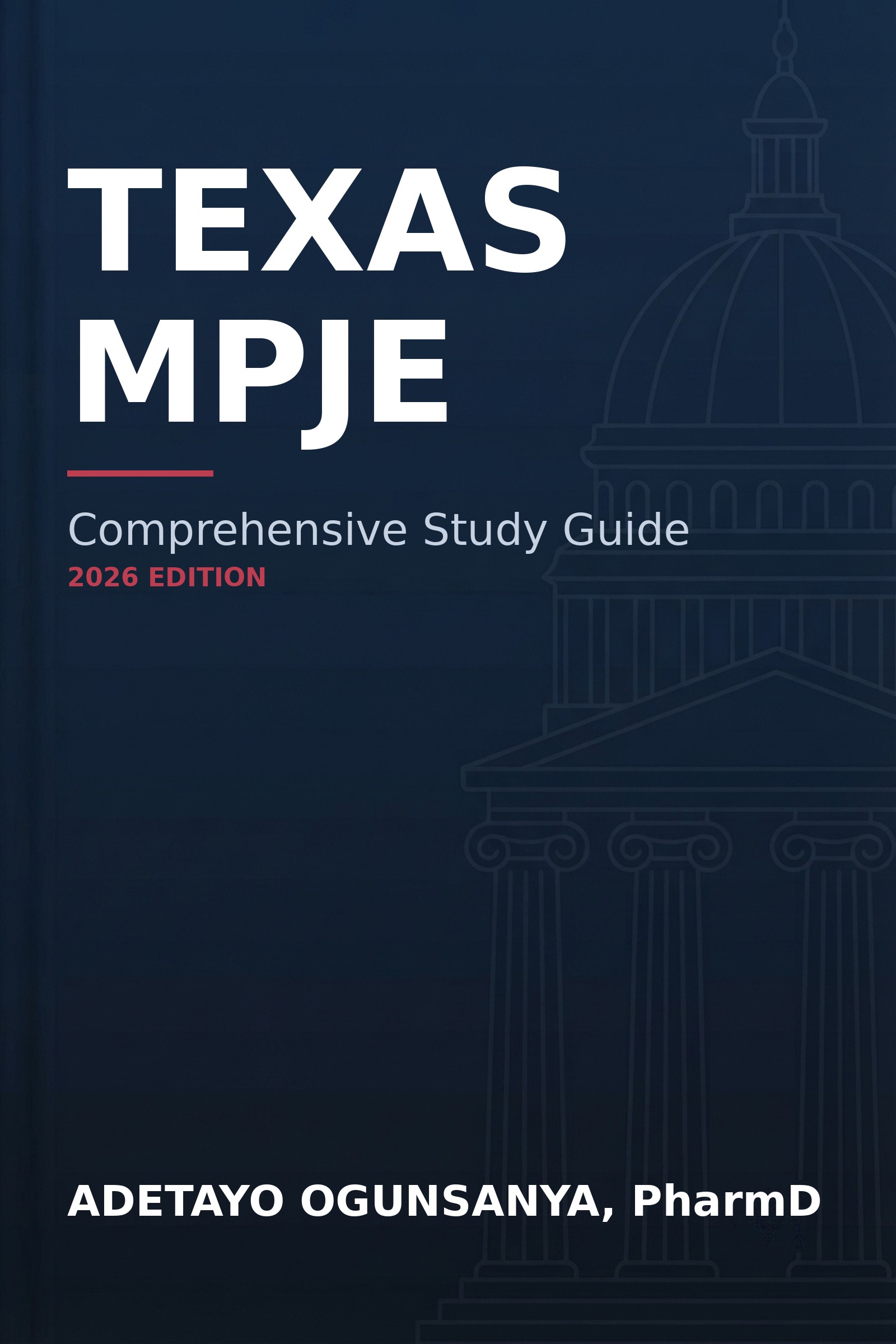
TX MPJE Complete Prep Package
The free guide above gets you oriented. This is the full build: 96 pages of Texas pharmacy law verified against current TSBP rules and the Texas Register, plus 120 original scenario questions — each with a full rationale, an explanation of why every wrong answer fails, and a specific rule citation.
State + Federal · 96 pages · $120.00