Preparing for the New York MPJE can feel like being handed a box of legal puzzle pieces without a picture of the finished puzzle. You may find yourself moving between New York statutes, Board of Regents rules, Commissioner’s regulations, controlled-substance requirements, federal pharmacy law, professional-practice guidance, and pages of exceptions. Even pharmacists with years of experience can feel overwhelmed by the volume of material. I understand that pressure because I have taken and passed the New York MPJE. As a pharmacist licensed in New York and several other jurisdictions, one of the most important lessons I learned was that passing the NY MPJE is not simply about memorizing hundreds of isolated facts. You must understand how the laws apply when a pharmacist is presented with a real-world situation. In this article, I will explain how I approached the New York pharmacy law exam, what topics deserve your attention, common mistakes to avoid, and how to use my free New York MPJE study guide to prepare more efficiently. Looking for the Free New York MPJE Study Guide? You can download my free NY MPJE study guide below. The guide organizes important New York pharmacy law topics into a faster, easier-to-review format. It is designed for pharmacy graduates, pharmacists transferring their licenses to New York, and candidates who need a focused review before exam day.
Get the Free NY MPJE Study Guide
The free New York MPJE Quick Facts Guide is ready. Enter your email and we’ll send it to your inbox right away. — you'll also get MPJE law updates and study tips going forward.
Do not wait until the night before the exam to open it. Use the guide alongside the official New York laws and regulations, then return to it during your final review.
How Do You Pass the New York MPJE?
To pass the New York MPJE, focus on understanding how New York pharmacy law applies to realistic practice situations. A strong preparation strategy should include:
- Reviewing the official New York MPJE study materials.
- Separating federal requirements from New York requirements.
- Learning when New York law is stricter than federal law.
- Studying prescription-processing scenarios.
- Reviewing controlled-substance requirements carefully.
- Practicing questions that require judgment, not just recall.
- Using a condensed guide during your final review.
New York currently requires applicants seeking pharmacist licensure in the state to pass the New York-specific MPJE. The New York State Education Department also provides an official MPJE preparation page with links to applicable laws, regulations, professional-practice information, controlled-substance resources, and federal materials.
Why Is the New York MPJE So Difficult?
The NY MPJE is difficult because the information candidates need is not contained in one perfect textbook. Important rules may be found in different places, including:
- New York Education Law
- Article 137 governing pharmacy
- Part 63 of the Commissioner’s Regulations
- Part 29 concerning unprofessional conduct
- New York Public Health Law
- Controlled-substance regulations
- Board of Pharmacy guidance and frequently asked questions
- Federal statutes and regulations
The New York State Education Department’s pharmacy law page specifically directs readers to Article 137, Part 29, Part 52.29, Part 63, and other applicable laws and regulations. The challenge is not merely finding these materials. You must connect them. A question may involve several issues at once:
- Who issued the prescription?
- Does the prescriber have authority?
- Is the prescription valid?
- Is the medication controlled?
- Can it be transferred or refilled?
- Is an emergency supply permitted?
- What documentation must the pharmacist maintain?
- Does federal or New York law impose the stricter requirement?
That is why reading the laws once from beginning to end may not be enough.
What I Learned From Passing the NY MPJE
My biggest takeaway was that pharmacy law must be studied through decisions. Instead of asking only: What is the rule? Ask: What would the pharmacist legally be allowed or required to do in this situation? For every major topic, I recommend answering five questions: 1. Who is authorized to perform the action? 2. What conditions must be met? 3. When must the action occur? 4. What documentation must be created or maintained? 5. What would make the action prohibited? This approach turns a dense paragraph of legal language into a practical decision-making framework. For example, do not merely memorize that certain pharmacy personnel may assist a pharmacist. Understand which tasks may be delegated, which tasks require professional judgment, how different personnel are classified, and who remains responsible for the final prescription. The examination is designed around the application of pharmacy laws and regulations. NABP advises candidates to use the MPJE competency statements to understand the topics covered on examinations administered before March 1, 2027.
What Should You Study for the New York MPJE?
Your preparation should cover both federal pharmacy law and New York-specific requirements. The following areas deserve careful attention.
1. Pharmacist Licensure and Professional Responsibilities
Review:
- Requirements for pharmacist licensure
- Registration and renewal requirements
- Continuing education
- Professional misconduct
- Supervising pharmacist responsibilities
- Reporting obligations
- Pharmacy ownership and registration
- Nonresident pharmacy requirements
- Grounds for discipline
Do not assume that administrative topics are low yield. A question about reporting, registration, supervision, or professional misconduct can be just as important as a question about dispensing.
2. Prescription Requirements
Know how to evaluate a prescription from the moment it reaches the pharmacy. Study:
- Required prescription elements
- Prescriber authority
- Electronic prescriptions
- Oral prescriptions
- Faxed prescriptions
- Emergency prescriptions
- Prescription alterations
- Generic substitution
- Patient counseling
- Labeling
- Language-access requirements
- Prescription records
Practice deciding whether a pharmacist may dispense, must clarify the prescription, or must refuse to fill it.
3. Controlled Substances
Controlled-substance law is an area where small details can change the answer. Review:
- Scheduling
- Prescriber registration and authority
- Official prescription requirements
- Electronic prescribing
- Emergency oral prescriptions
- Refills
- Partial filling
- Transfers
- Inventory requirements
- Record keeping
- Loss or theft
- Disposal
- Corresponding responsibility
- Federal versus New York restrictions
The New York MPJE preparation page directs candidates to controlled-substance and official prescription information maintained by the New York State Department of Health’s Bureau of Narcotic Enforcement. Create a comparison chart rather than trying to hold every controlled-substance rule in your head as a loose collection of numbers.
4. Pharmacy Personnel
Understand the roles of:
- Pharmacists
- Supervising pharmacists
- Pharmacy interns
- Registered pharmacy technicians
- Unlicensed personnel
- Other authorized healthcare professionals
Pay attention to supervision, ratios, delegated activities, prohibited activities, and responsibility for the final prescription. New York’s official pharmacy FAQs, for example, distinguish unlicensed personnel involved in filling prescriptions from staff performing unrelated duties and explain how interns are treated for staffing-ratio purposes. This is precisely the kind of rule that can be converted into a scenario.
5. Pharmacy Operations
Study the legal requirements governing the operation of a pharmacy, including:
- Pharmacy registration
- Required signage and references
- Hours of operation
- Security
- Prescription departments
- Drug storage
- Record retention
- Pharmacy closure
- Transfer of prescription records
- Automated systems
- Centralized services
- Delivery and mailing
- Nonresident pharmacies
These rules may appear administrative, but the exam can test them by placing you in the role of the pharmacist responsible for an establishment.
6. Compounding
Review both state and federal requirements involving:
- Nonsterile compounding
- Sterile compounding
- Personnel training
- Facilities and equipment
- Documentation
- Beyond-use dating
- Patient-specific compounding
- Office-use preparations
- Outsourcing facilities
- Prohibited compounding activities
Be careful not to rely solely on habits from your workplace. The exam tests legal requirements, not necessarily what a particular employer permits through a stricter internal policy.
7. Immunization and Expanded Pharmacy Services
Study:
- Pharmacist authorization
- Certification requirements
- Eligible patients
- Permitted vaccines
- Protocols or prescriptions
- Training
- Documentation
- Reporting
- Emergency preparedness
Article 137 includes New York requirements concerning pharmacist certificates of administration, so this material should be reviewed from the current official source rather than an old set of notes.
8. Federal Pharmacy Law
Do not study New York law in isolation. Review major federal topics involving:
- Controlled substances
- Prescription and over-the-counter drug requirements
- Drug recalls
- Misbranding and adulteration
- Drug samples
- Poison prevention packaging
- Patient privacy
- Medicare and Medicaid fraud
- Hazardous substances
- Pseudoephedrine sales
- Prescription drug marketing
- Compounding
When federal and state laws both apply, identify which requirement is stricter and whether compliance with one law automatically satisfies the other.
My Recommended NY MPJE Study Method
Here is a practical way to organize your preparation.
Step 1: Begin With the Official Study Materials
Start with the New York State Education Department’s MPJE requirements page and its linked laws, regulations, and guidance. Third-party resources can simplify the material, but they should not replace primary sources. Pharmacy laws change, and older summaries may preserve rules that have already been amended. New York itself warns that statutes and regulations are subject to change and advises readers to consult current official sources and subsequent amendments.
Step 2: Build a Topic Checklist
Divide the material into manageable categories:
- Licensure
- Personnel
- Prescriptions
- Controlled substances
- Pharmacy operations
- Records
- Compounding
- Immunization
- Institutional practice
- Federal law
Mark each topic as:
- Not reviewed
- Reviewed once
- Needs practice
- Exam ready
This gives you a visible map of your progress.
Step 3: Create Comparison Tables
Comparison tables are especially useful for:
- Federal law versus New York law
- Controlled-substance schedules
- Refill and partial-fill rules
- Prescription types
- Personnel responsibilities
- Record-retention periods
- Reporting deadlines
MPJE questions frequently become difficult when two similar rules are placed next to each other.
Step 4: Convert Rules Into Scenarios
After reviewing a rule, create a short situation. For example: A pharmacist receives an otherwise valid prescription, but one element does not satisfy a New York requirement. Can the pharmacist correct it, contact the prescriber, document the change, or refuse to dispense it? A good scenario forces you to identify the law, apply it, and choose the correct pharmacist action.
Step 5: Keep a “Frequently Confused” List
Write down every rule you repeatedly mix up. Your list may include:
- Similar deadlines
- Different record-retention requirements
- Refill versus partial-fill rules
- Pharmacist versus intern authority
- Controlled versus noncontrolled prescriptions
- Federal versus state requirements
- Prescriber-specific restrictions
Review this list daily. It will likely be more valuable during the final 48 hours than rereading hundreds of pages.
Step 6: Use the Free Guide for Consolidation
My free New York MPJE study guide is designed to help you organize and reinforce the material you have studied. Use it:
- After your first review of the official laws
- When identifying weak areas
- During practice-question review
- During the final week
- The day before your examination
Get the Free NY MPJE Study Guide
The free New York MPJE Quick Facts Guide is ready. Enter your email and we’ll send it to your inbox right away. — you'll also get MPJE law updates and study tips going forward.
A Seven-Day New York MPJE Study Plan
Candidates have different timelines, but the following structure can help if your examination is approaching quickly.
Day 1: Licensure and Pharmacy Operations
Review pharmacist licensure, registration, establishment requirements, supervising pharmacists, professional misconduct, inspections, closures, and records.
Day 2: Prescription Requirements
Study prescription validity, prescriber authority, electronic prescriptions, oral prescriptions, labeling, substitution, counseling, transfers, and refills.
Day 3: Controlled Substances
Focus on prescription requirements, emergency situations, refills, partial fills, transfers, inventories, records, reporting, disposal, and corresponding responsibility.
Day 4: Pharmacy Personnel and Scope of Practice
Review pharmacists, interns, registered technicians, unlicensed personnel, delegation, immunization, collaborative practice, and other authorized services.
Day 5: Compounding and Specialized Practice Settings
Cover sterile and nonsterile compounding, institutional pharmacies, automated systems, central services, and nonresident practice.
Day 6: Federal Law and Mixed Scenarios
Review major federal laws and practice questions that combine state and federal requirements.
Day 7: Final Review
Use your condensed notes and the free NY MPJE study guide. Review confusing comparisons, missed questions, deadlines, prohibited conduct, and pharmacist responsibilities. Avoid spending the entire final day learning brand-new material. Strengthen what you already know.
Common NY MPJE Study Mistakes
Mistake 1: Memorizing Without Understanding
Knowing a deadline is useful. Understanding what triggers that deadline is more important. Always connect each number to:
- The event
- The responsible person
- The required action
- The documentation
Mistake 2: Studying From Only One Resource
No unofficial guide should be treated as the law itself. Use a reliable study guide to organize the material, then verify important rules through current New York and federal sources.
Mistake 3: Ignoring Exceptions
Words such as “unless,” “except,” “provided that,” and “only if” can completely change a rule. Slow down when you encounter exceptions.
Mistake 4: Relying Only on Pharmacy Work Experience
What your workplace does may be based on company policy, another state’s law, accreditation standards, or a deliberately conservative procedure. For the exam, answer according to the applicable law.
Mistake 5: Avoiding Scenario-Based Questions
Recognizing a rule on a flashcard does not guarantee that you can apply it in a complicated prescription scenario. Practice choosing the best legal action available to the pharmacist.
Mistake 6: Treating Every Topic as Equally Difficult
Spend more time on topics that require comparisons, exceptions, calculations, or multistep reasoning. Do not repeatedly review material you already know simply because it feels comfortable.
What Should You Do the Day Before the NY MPJE?
The day before the examination, focus on consolidation. Review:
- Your frequently confused rules
- Controlled-substance comparisons
- Prescription validity
- Personnel responsibilities
- Reporting requirements
- Record-retention periods
- Common exceptions
- Questions you previously answered incorrectly
Avoid opening ten new resources and creating a legal blizzard in your brain. Use one organized final-review document.
Get the Free NY MPJE Study Guide
The free New York MPJE Quick Facts Guide is ready. Enter your email and we’ll send it to your inbox right away. — you'll also get MPJE law updates and study tips going forward.
Get adequate sleep, confirm your examination arrangements, and arrive prepared to read every question carefully.
Is the New York MPJE Based Only on New York Law?
No. Candidates should prepare for both New York-specific law and applicable federal pharmacy law. The critical skill is understanding how the two systems interact. When both laws apply, the pharmacist generally must comply with the requirement that is more restrictive, unless the laws cannot legally be reconciled or a specific exception applies. This is why a state-versus-federal comparison sheet can be so valuable.
How Long Should You Study for the NY MPJE?
There is no universal timeline. Your ideal preparation period depends on:
- Your familiarity with New York pharmacy practice
- Whether you recently graduated
- Whether you are transferring from another state
- How long it has been since you studied federal law
- The number of hours you can study each day
- Your performance on scenario-based questions
A focused candidate may make significant progress in one or two weeks, while someone balancing full-time work and family responsibilities may need a longer schedule. The quality of your preparation matters more than collecting an impressive number of study hours.
Can You Pass the New York MPJE on the First Attempt?
Yes, but passing requires more than casually reading a summary. Give yourself the best opportunity by:
- Starting with official materials
- Organizing the law by topic
- Comparing similar rules
- Practicing scenarios
- Reviewing your mistakes
- Using a condensed guide for final preparation
Do not interpret a difficult practice session as proof that you cannot pass. Difficult questions reveal where your legal reasoning needs reinforcement.
Download the Free New York MPJE Study Guide
I created this free guide to make New York pharmacy law easier to organize, review, and apply. It is intended to help you spend less time wandering through disconnected materials and more time mastering the rules that affect pharmacy practice. Inside the guide, you will find a focused review of important NY MPJE topics, high-yield reminders, commonly confused rules, and material you can revisit as your examination approaches.
Get the Free NY MPJE Study Guide
The free New York MPJE Quick Facts Guide is ready. Enter your email and we’ll send it to your inbox right away. — you'll also get MPJE law updates and study tips going forward.
You can also explore my other pharmacy law resources:
- New Jersey MPJE Study Guide →
- Washington, DC MPJE Study Guide →
- Texas MPJE Study Guide →
- Federal Pharmacy Law Study Guide →
- MPJE Practice Questions →
Bookmark this page and return to it as you move through your study plan.
Final Thoughts
The New York MPJE is challenging, but the material becomes more manageable when you stop treating it as an enormous pile of disconnected rules. Organize the law. Compare similar requirements. Study through realistic situations. Keep track of your weak areas. Verify important information using current official sources. Most importantly, prepare to think like the pharmacist who is legally responsible for the decision. That shift helped me approach the New York MPJE with greater clarity, and it can help you prepare more effectively too.
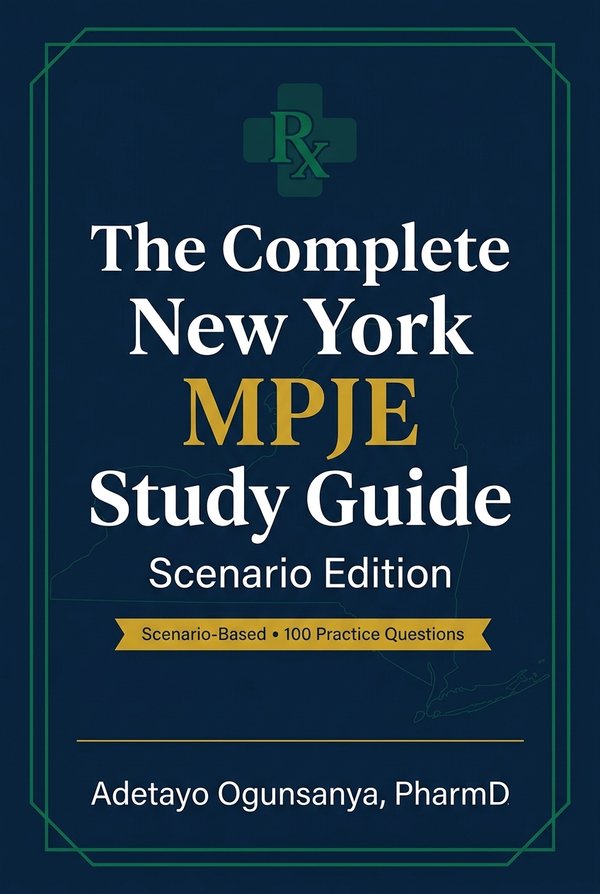
The Complete New York MPJE Study Guide
The free guide above gets you oriented. This is the full build: 33 chapters of scenario-based New York pharmacy law with federal comparisons, the traps that catch first-time takers, a 100-question exam plus 20 bonus questions, and a full rationale for every answer — written by a licensed pharmacist.
Scenario Edition · 103 pages · $120.00
Ready to practice?
The New York MPJE Question Bank puts this material into scenario questions weighted to the NABP competency areas — and every question shows the statute or regulation it rests on, with the date it was last checked against the primary source.