
Three questions from the exam
These are three of the 100, with every option explained, so you can judge the style before you buy.
Sample question 9
A 63-year-old man who currently smokes and had a myocardial infarction 3 years ago has moderately to severely active rheumatoid arthritis despite methotrexate. He has never taken a TNF blocker. His rheumatologist prescribes tofacitinib extended-release tablets. Which pharmacist response is most appropriate?
- A. Dispense as written, because the label allows tofacitinib after an inadequate response to methotrexate alone.
- B. Dispense as written, because smoking history and a prior MI do not alter the labeled benefit-risk assessment.
- C. Dispense as written, because the extended-release tablet has no requirement for prior treatment with a TNF blocker.
- D. Dispense as written, because the boxed warning for cardiovascular events and thrombosis applies only to patients younger than 50 years of age.
- E. Contact the prescriber, because RA use is limited to patients who failed or could not take a TNF blocker.
Show the answer and explanations
Answer: E.
- A. Incorrect. The labeled RA indication requires an inadequate response or intolerance to one or more TNF blockers, not only to methotrexate.
- B. Incorrect. The label advises considering benefits and risks, particularly in current or past smokers, and reports higher MACE in RA patients 50 or older with at least one cardiovascular risk factor.
- C. Incorrect. The extended-release tablet label carries the same indication: RA in patients with inadequate response or intolerance to one or more TNF blockers.
- D. Incorrect. The label's MACE finding came from patients with RA aged 50 years and older with at least one cardiovascular risk factor, so the warning is not limited to those younger than 50.
- E. Correct. The tofacitinib extended-release label indicates it for RA in adults who have had an inadequate response or intolerance to one or more TNF blockers, and this patient is TNF-blocker naive; the label also highlights higher MACE rates in patients 50 and older with a cardiovascular risk factor and extra risk in current or past smokers.
Sample question 10
During general anesthesia, a 24-year-old man develops hypercarbia, muscle rigidity, tachycardia, and a rapidly rising temperature consistent with malignant hyperthermia. Dantrolene sodium for injection is given by rapid intravenous push. Which statement best reflects how the dantrolene label describes its action?
- A. It blocks nicotinic acetylcholine receptors at the neuromuscular junction, preventing depolarization of the motor end plate.
- B. It dissociates excitation-contraction coupling, probably by interfering with Ca2+ release from the sarcoplasmic reticulum.
- C. It lowers the hypothalamic temperature set point, which reverses the hypermetabolic state and reduces core body temperature.
- D. It blocks calcium entry through L-type channels in vascular smooth muscle, relieving the vasospasm that causes the hyperthermia.
- E. It activates GABA-B receptors in the spinal cord, reducing reflex excitation of skeletal muscle and relieving the rigidity.
Show the answer and explanations
Answer: B.
- A. Incorrect. The label states dantrolene affects the contractile response of muscle at a site beyond the myoneural junction, not at the nicotinic receptor.
- B. Correct. The label calls dantrolene a direct-acting skeletal muscle relaxant that, in skeletal muscle, dissociates excitation-contraction coupling, probably by interfering with release of Ca++ from the sarcoplasmic reticulum; it is hypothesized to re-establish a normal level of ionized calcium in the myoplasm of the triggered malignant hyperthermia muscle cell.
- C. Incorrect. The label describes an intrinsic abnormality of skeletal muscle tissue in malignant hyperthermia and classifies dantrolene as a direct-acting skeletal muscle relaxant that acts in skeletal muscle; it does not describe a change in the hypothalamic temperature set point.
- D. Incorrect. The label attributes the effect to inhibition of calcium release from the sarcoplasmic reticulum; it also warns against combining intravenous dantrolene with calcium channel blockers such as verapamil because of cardiovascular collapse with hyperkalemia.
- E. Incorrect. The label classifies dantrolene as a direct-acting skeletal muscle relaxant acting in skeletal muscle on excitation-contraction coupling; it does not describe spinal GABA-B receptor activation.
Sample question 47
A 74-year-old woman has hypertension and hyperlipidemia but no history of coronary disease, stroke, or GI bleeding. She asks the pharmacist whether she should start over-the-counter aspirin 81 mg daily 'to prevent a heart attack.' According to the 2023 AGS Beers Criteria, what is the best recommendation?
- A. Advise starting aspirin 81 mg, because the Beers Criteria apply only to adults who are 80 years old or older.
- B. Advise starting enteric-coated aspirin 81 mg, because the coating makes initiation acceptable under the Beers Criteria.
- C. Advise against starting aspirin for primary prevention, because the Beers Criteria recommend avoiding its initiation in older adults.
- D. Advise starting aspirin 81 mg, because hypertension and hyperlipidemia make the Beers primary-prevention criterion inapplicable.
- E. Advise starting aspirin 81 mg every other day, which the Beers Criteria identify as an acceptable reduced-risk regimen for older adults.
Show the answer and explanations
Answer: C.
- A. Incorrect. The criteria are intended for adults 65 years old and older, and this criterion has no 80-year age cutoff.
- B. Incorrect. The 2023 criterion is to avoid initiating aspirin for the primary prevention of cardiovascular disease in older adults; it is stated for aspirin without limiting it to a particular formulation.
- C. Correct. The 2023 Beers Criteria moved aspirin to the 'avoid' table: avoid initiating aspirin for the primary prevention of cardiovascular disease in older adults, in agreement with the USPSTF.
- D. Incorrect. The criterion addresses primary prevention (no established cardiovascular disease), which is exactly her situation; risk factors such as hypertension do not make the recommendation inapplicable.
- E. Incorrect. The criterion is to avoid initiating aspirin for primary prevention (and to consider deprescribing in current users); the criterion text contains no acceptable reduced-frequency regimen.
Built to the NABP blueprint
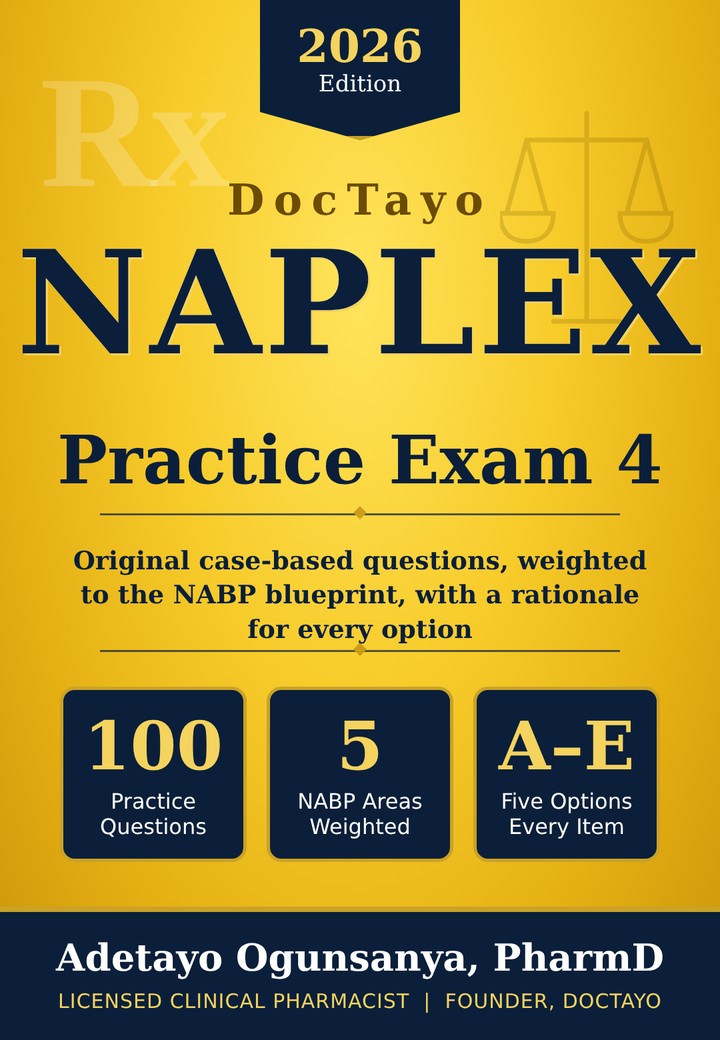
The NABP NAPLEX Content Outline (effective 1 May 2025) weights the exam across five areas. This practice exam follows the same weights, so your score by area shows where you stand against how the real exam is distributed. It is shorter than the real exam and is not adaptive. Check the current NABP candidate bulletin for anything administrative, because NABP can change it.
Is this for you?
Yes, if…
You are preparing for the NAPLEX and want a realistic, case-based check of where you stand by content area, with explanations that teach the reasoning.
No, if…
You are looking for released or recalled NABP questions. These questions are original, modeled on the NAPLEX style and blueprint. They are not NABP items. If you are preparing for the MPJE instead, see the UMPJE practice exam.
Questions before you buy
What if it isn't right for me?
Email support@doctayo.com within 30 days and you get your money back in full. See the refund policy.
What format is it?
A 101-page PDF, delivered by email immediately after purchase. Your copy carries your email address and order number on each page, so please do not share it. There is no subscription and no expiry.
Are these real NAPLEX questions?
No. Every question is original and written for this exam. They follow the NAPLEX style (a short case, five options, one best answer) and the NABP content weighting, but they are not released or recalled NABP items.
Does a good score mean I will pass?
No. NABP sets the real passing standard and this exam is shorter and not adaptive. Use your area scores to see where your preparation is thin.
How current is it?
Questions were written in November 2026 from FDA labeling and current guidelines, and each explanation lists its source basis and, where a source could be checked, a reference number. Drug information changes, so confirm anything you rely on in practice at the source. If you find an error, email support@doctayo.com.
See where you stand.
100 questions · every option explained · scored by NABP area
Digital download · Immediate access · 30-day money-back guarantee