
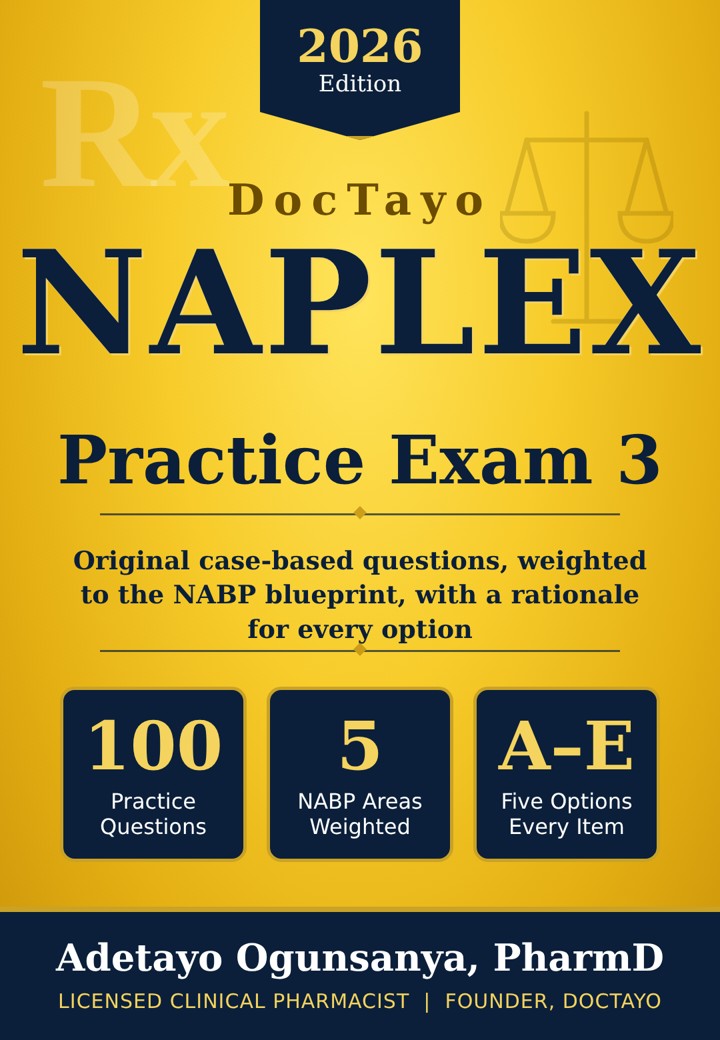
Three questions from the exam
These are three of the 100, with every option explained, so you can judge the style before you buy.
Sample question 9
A 163-lb adult (use 2.2 lb = 1 kg) with Burkitt lymphoma and a documented normal G6PD result will start chemotherapy. The prescriber orders rasburicase 0.2 mg/kg IV once daily. Rasburicase is supplied as 7.5-mg single-dose vials of lyophilized powder. What is the first daily dose, and how many vials must be reconstituted to supply it?
- A. 1.5 mg; 1 vial
- B. 7.5 mg; 1 vial
- C. 14.8 mg; 2 vials
- D. 32.6 mg; 5 vials
- E. 74.1 mg; 10 vials
Show the answer and explanations
Answer: C.
- A. Incorrect. This is a decimal-place error (0.02 mg/kg x 74.09 kg = 1.5 mg), ten times too low for the ordered 0.2 mg/kg.
- B. Incorrect. One vial (7.5 mg) is a fixed-vial dose that ignores weight-based dosing; 7.5 mg is only about 0.1 mg/kg for this patient, half of the ordered 0.2 mg/kg.
- C. Correct. 163 lb / 2.2 = 74.09 kg; 74.09 kg x 0.2 mg/kg = 14.8 mg. 14.8 mg / 7.5 mg per vial = 1.98, so two vials (15 mg) supply the dose. The label dose is 0.2 mg/kg as a 30-minute IV infusion once daily for up to 5 days.
- D. Incorrect. This multiplies 0.2 mg/kg by the weight in pounds (163 x 0.2 = 32.6 mg; 32.6 / 7.5 = 4.3, rounded to 5 vials) and skips the pound-to-kilogram conversion.
- E. Incorrect. This is the total for a 5-day course (14.8 mg x 5 = 74.1 mg; 9.9, about 10 vials). The ordered and labeled dose is given once daily, so each day's dose is prepared separately.
Sample question 10
A 46-year-old woman who weighs 52 kg has taken hydroxychloroquine 400 mg once daily for systemic lupus erythematosus for 2 years. She has normal kidney function, takes no other medications and has no visual symptoms. A baseline eye examination in her first year was normal. Which plan is the most appropriate?
- A. Reduce the dose to 200 mg daily and arrange annual retinal examinations
- B. Continue 400 mg daily and defer retinal examinations until she completes 5 years of therapy
- C. Reduce the dose to 300 mg daily and defer retinal examinations until 5 years of therapy
- D. Continue 400 mg daily and arrange annual retinal examinations
- E. Hold hydroxychloroquine until a repeat retinal examination is completed
Show the answer and explanations
Answer: A.
- A. Correct. 400 mg / 52 kg = 7.7 mg/kg/day, above the 5 mg/kg actual-body-weight daily dose that the label lists as a risk factor for retinal damage. Reducing to 200 mg (3.8 mg/kg) lowers the risk, and because she has had an excess dose, annual screening is appropriate. The label lists visual acuity, automated visual field and SD-OCT; the revised AAO recommendations (ratified October 2025) name OCT with wide-pattern fundus autofluorescence as the primary tests, with visual fields and mfERG as adjuncts.
- B. Incorrect. At 7.7 mg/kg/day she has a labeled risk factor for retinal damage. Annual examinations can be deferred until 5 years only for patients without significant risk factors, and the dose should be reduced.
- C. Incorrect. 300 mg is 5.8 mg/kg/day, which is still above 5 mg/kg, and deferring examinations is not appropriate in a patient with this risk factor.
- D. Incorrect. Annual examinations are appropriate, but continuing 400 mg (7.7 mg/kg/day) leaves her above the 5 mg/kg/day level associated with increased retinopathy.
- E. Incorrect. The label advises discontinuing hydroxychloroquine if ocular toxicity is suspected. She has no visual symptoms or findings, so holding therapy is not necessary; dose reduction with monitoring is.
Sample question 47
An 82-kg adult has a methicillin-resistant Staphylococcus aureus bloodstream infection. His creatinine clearance is 24 mL/min and he is not receiving dialysis. Using the daptomycin labeling for S. aureus bloodstream infections, which regimen is correct?
- A. 328 mg IV every 48 hours
- B. 328 mg IV every 24 hours
- C. 492 mg IV every 48 hours
- D. 492 mg IV every 24 hours
- E. 820 mg IV every 48 hours
Show the answer and explanations
Answer: C.
- A. Incorrect. 4 mg/kg (82 x 4 = 328 mg) is the complicated skin and skin structure infection dose, not the bloodstream infection dose, although the 48-hour interval is correct for his renal function.
- B. Incorrect. 328 mg every 24 hours is the skin and skin structure infection regimen for patients with CrCl of 30 mL/min or more; it is wrong on both dose and interval for this patient.
- C. Correct. For S. aureus bloodstream infections the label dose is 6 mg/kg (82 x 6 = 492 mg), and for CrCl below 30 mL/min the interval is extended to once every 48 hours.
- D. Incorrect. 6 mg/kg is the right bacteremia dose (492 mg), but once every 24 hours is the regimen for CrCl of 30 mL/min or more; with CrCl below 30 mL/min the interval must be 48 hours.
- E. Incorrect. 10 mg/kg (820 mg) exceeds the labeled maximum; the label states doses in excess of 6 mg/kg have not been approved for adults.
Built to the NABP blueprint
The NABP NAPLEX Content Outline (effective 1 May 2025) weights the exam across five areas. This practice exam follows the same weights, so your score by area shows where you stand against how the real exam is distributed. It is shorter than the real exam and is not adaptive. Check the current NABP candidate bulletin for anything administrative, because NABP can change it.
Is this for you?
Yes, if…
You are preparing for the NAPLEX and want a realistic, case-based check of where you stand by content area, with explanations that teach the reasoning.
No, if…
You are looking for released or recalled NABP questions. These questions are original, modeled on the NAPLEX style and blueprint. They are not NABP items. If you are preparing for the MPJE instead, see the UMPJE practice exam.
Questions before you buy
What if it isn't right for me?
Email support@doctayo.com within 30 days and you get your money back in full. See the refund policy.
What format is it?
A 97-page PDF, delivered by email immediately after purchase. Your copy carries your email address and order number on each page, so please do not share it. There is no subscription and no expiry.
Are these real NAPLEX questions?
No. Every question is original and written for this exam. They follow the NAPLEX style (a short case, five options, one best answer) and the NABP content weighting, but they are not released or recalled NABP items.
Does a good score mean I will pass?
No. NABP sets the real passing standard and this exam is shorter and not adaptive. Use your area scores to see where your preparation is thin.
How current is it?
Questions were written in November 2026 from FDA labeling and current guidelines, and each explanation lists its source basis and, where a source could be checked, a reference number. Drug information changes, so confirm anything you rely on in practice at the source. If you find an error, email support@doctayo.com.
See where you stand.
100 questions · every option explained · scored by NABP area
Digital download · Immediate access · 30-day money-back guarantee