
Three questions from the exam
These are three of the 100, with every option explained, so you can judge the style before you buy.
Sample question 9
A 66-year-old man with COPD and type 2 diabetes has radiographically confirmed community-acquired pneumonia and is well enough for outpatient care. He has not been hospitalized or received IV antibiotics in the past year, and he has no history of MRSA or Pseudomonas aeruginosa. He has no drug allergies. Which regimen is most appropriate?
- A. Piperacillin-tazobactam plus vancomycin IV to cover Pseudomonas aeruginosa and MRSA empirically
- B. Amoxicillin 1 g three times daily as a single agent, the regimen used for patients without comorbidities
- C. Doxycycline 100 mg twice daily as a single agent, the regimen used for patients without comorbidities
- D. Amoxicillin/clavulanate 875 mg/125 mg twice daily plus doxycycline 100 mg twice daily
- E. Azithromycin 500 mg on day 1 then 250 mg daily as a single agent, if local macrolide resistance is low
Show the answer and explanations
Answer: D.
- A. Incorrect. Anti-pseudomonal and anti-MRSA IV therapy is for patients with MRSA/P. aeruginosa risk factors (prior respiratory isolation, or recent hospitalization AND parenteral antibiotics in the last 90 days). He has neither, and he is stable for outpatient care.
- B. Incorrect. Amoxicillin 1 g three times daily alone is a standard regimen for healthy adults without comorbidities. COPD and diabetes place him in the comorbidity group, for which the guideline lists combination therapy (amoxicillin/clavulanate or a cephalosporin plus a macrolide or doxycycline) or a respiratory fluoroquinolone alone.
- C. Incorrect. Doxycycline alone is also a no-comorbidity option. Patients with comorbidities are recommended combination therapy (or fluoroquinolone monotherapy), so doxycycline is only the second drug of the combination.
- D. Correct. The 2019 ATS/IDSA guideline lists, for outpatients with comorbidities (chronic lung disease, diabetes), combination therapy: amoxicillin/clavulanate (875/125 mg twice daily is one listed dose) or a cephalosporin, plus a macrolide or doxycycline 100 mg twice daily; or a respiratory fluoroquinolone alone.
- E. Incorrect. A macrolide alone is listed only for patients without comorbidities and only where local pneumococcal macrolide resistance is below 25%. With comorbidities he needs combination therapy or a fluoroquinolone.
Sample question 10
Ketorolac is a weak organic acid with a pKa of 3.5. Using the Henderson-Hasselbalch equation, pH = pKa + log([ionized]/[un-ionized]), what percentage of ketorolac is in the un-ionized (more readily absorbed) form in gastric fluid at pH 2.5?
- A. 9%
- B. 10%
- C. 50%
- D. 91%
- E. 99%
Show the answer and explanations
Answer: D.
- A. Incorrect. 9% is the ionized fraction (0.10/1.10), not the un-ionized fraction.
- B. Incorrect. 10% results from reading the ionized-to-un-ionized ratio (0.10) as a percentage.
- C. Incorrect. 50% is the un-ionized fraction when pH equals the pKa (3.5), not at pH 2.5.
- D. Correct. For a weak acid, log([A-]/[HA]) = pH - pKa = 2.5 - 3.5 = -1.0, so [A-]/[HA] = 0.10. Un-ionized fraction = 1/(1 + 0.10) = 0.909, or about 91%.
- E. Incorrect. 99% results from using pH 1.5 (10^-2 = 0.01 ratio) instead of pH 2.5.
Sample question 47
A 34-year-old woman takes dolutegravir 50 mg once daily at bedtime for HIV. She recently started calcium carbonate 1,200 mg and a ferrous sulfate tablet at bedtime to help with heartburn and anemia. She goes to bed after an evening snack but does not eat anything with her bedtime medicines, so the doses are taken fasting. Which counseling is most appropriate?
- A. Continue taking all three together, since dolutegravir is unaffected by calcium and iron
- B. Increase dolutegravir to 50 mg twice daily so that enough drug is absorbed with the supplements
- C. Take dolutegravir 6 hours before, or 2 hours after, the calcium and iron supplements
- D. Take dolutegravir 2 hours before, or 6 hours after, the calcium and iron supplements
- E. Take dolutegravir 1 hour before the supplements, because 1 hour of separation is enough
Show the answer and explanations
Answer: D.
- A. Incorrect. Calcium and iron supplements decrease dolutegravir levels; they may be taken at the same time only when taken with food, not when fasting.
- B. Incorrect. Twice-daily dolutegravir is the label adjustment for coadministration with potent inducers such as rifampin, not for cation chelation, which is handled by timing.
- C. Incorrect. This reverses the intervals. The label gives 2 hours before or 6 hours after, not 6 before or 2 after.
- D. Correct. Under fasting conditions the dolutegravir label says to take it 2 hours before or 6 hours after supplements containing calcium or iron (polyvalent cations lower dolutegravir exposure). Taking both together with a meal is the alternative, but she takes them fasting.
- E. Incorrect. The label does not support a 1-hour separation; it specifies 2 hours before or 6 hours after when fasting.
Built to the NABP blueprint
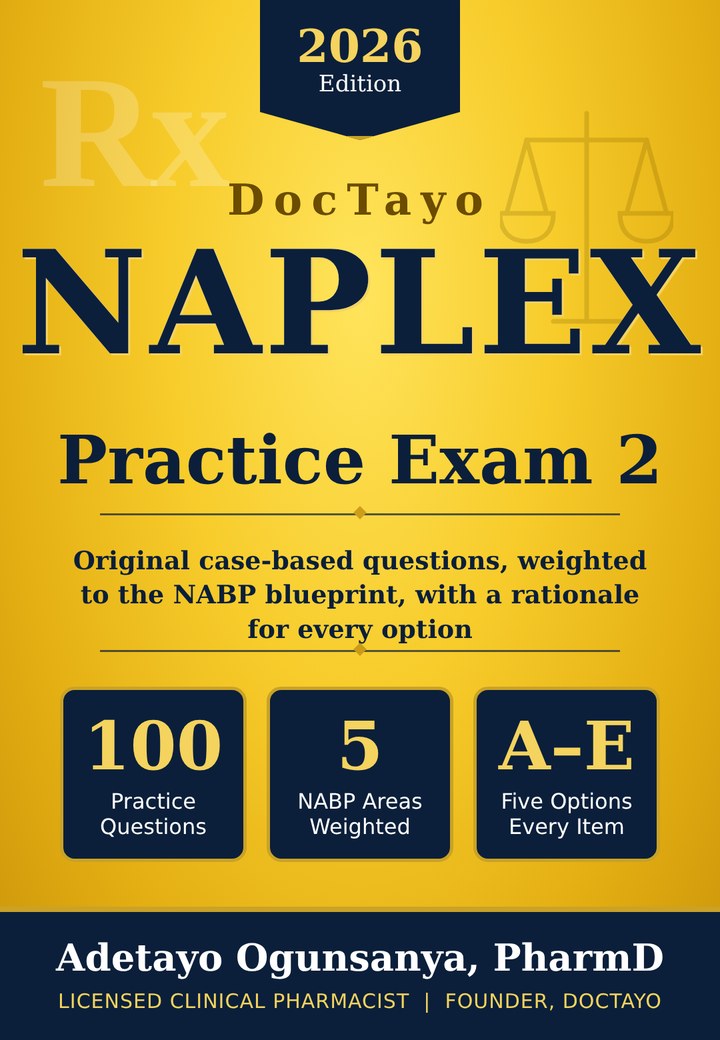
The NABP NAPLEX Content Outline (effective 1 May 2025) weights the exam across five areas. This practice exam follows the same weights, so your score by area shows where you stand against how the real exam is distributed. It is shorter than the real exam and is not adaptive. Check the current NABP candidate bulletin for anything administrative, because NABP can change it.
Is this for you?
Yes, if…
You are preparing for the NAPLEX and want a realistic, case-based check of where you stand by content area, with explanations that teach the reasoning.
No, if…
You are looking for released or recalled NABP questions. These questions are original, modeled on the NAPLEX style and blueprint. They are not NABP items. If you are preparing for the MPJE instead, see the UMPJE practice exam.
Questions before you buy
What if it isn't right for me?
Email support@doctayo.com within 30 days and you get your money back in full. See the refund policy.
What format is it?
A 96-page PDF, delivered by email immediately after purchase. Your copy carries your email address and order number on each page, so please do not share it. There is no subscription and no expiry.
Are these real NAPLEX questions?
No. Every question is original and written for this exam. They follow the NAPLEX style (a short case, five options, one best answer) and the NABP content weighting, but they are not released or recalled NABP items.
Does a good score mean I will pass?
No. NABP sets the real passing standard and this exam is shorter and not adaptive. Use your area scores to see where your preparation is thin.
How current is it?
Questions were written in November 2026 from FDA labeling and current guidelines, and each explanation lists its source basis and, where a source could be checked, a reference number. Drug information changes, so confirm anything you rely on in practice at the source. If you find an error, email support@doctayo.com.
See where you stand.
100 questions · every option explained · scored by NABP area
Digital download · Immediate access · 30-day money-back guarantee